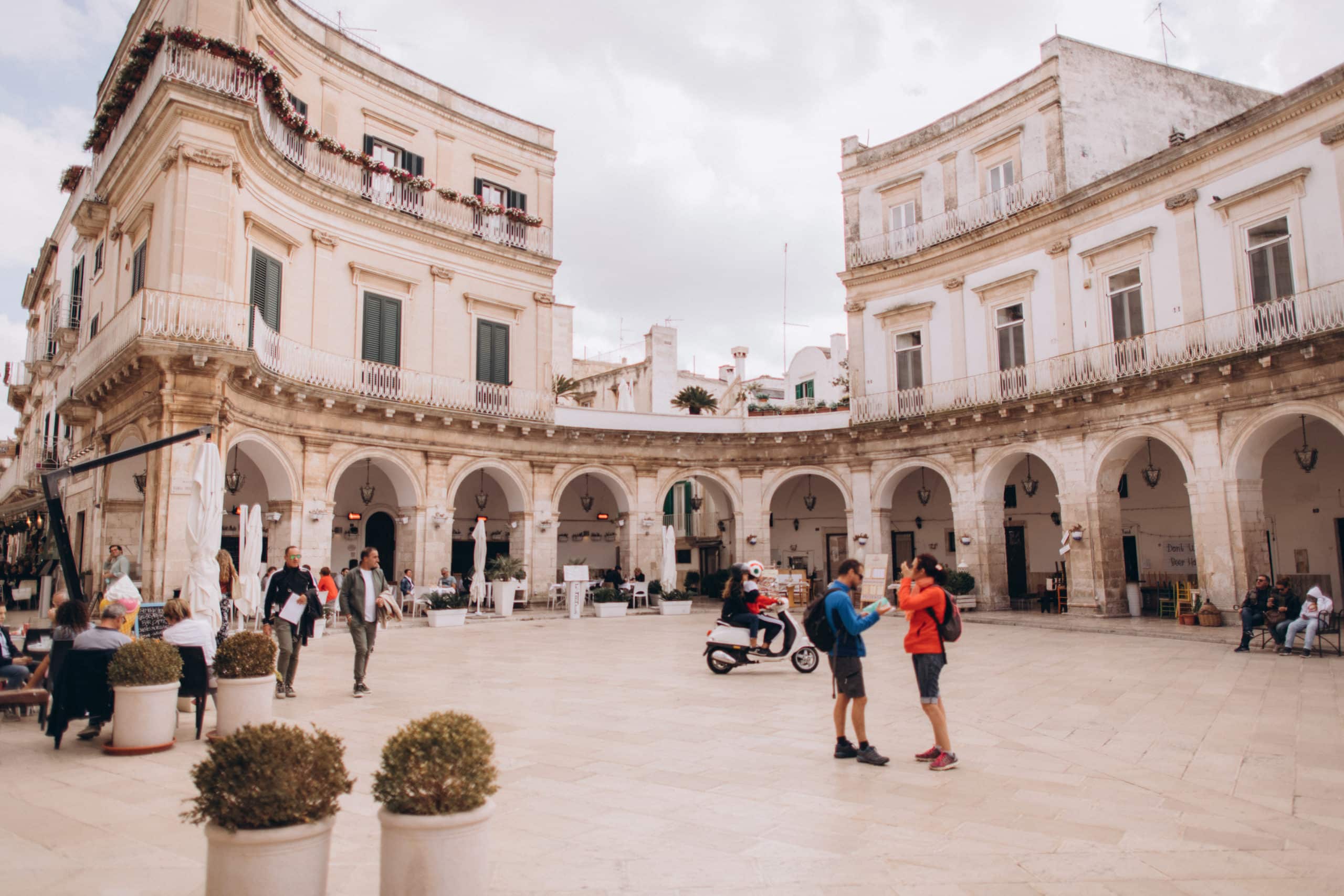
When I first wrote about Puglia outside summer, most international travellers still thought of the region almost entirely as a beach destination. That has changed. Bari, Lecce, Monopoli, Ostuni and the towns of Valle d’Itria do not disappear when the lidos close — their rhythm simply changes.
I would not sell November or January as “summer without the crowds”. It is a different trip. The sea becomes the backdrop, while towns, food, olive oil, wine, museums, masserie and local traditions move to the foreground.
When is the off-season in Puglia?
I roughly think of October to April as the quieter season, but October, January and March are very different experiences. October can still bring beautifully warm days. December is about Christmas atmosphere. January and February suit travellers who care more about towns, food and quiet than beaches, while spring brings the region back to life quickly.
Why visit Puglia outside summer?
- Historic centres are far easier to explore without summer heat and August crowds.
- Restaurants and everyday city life feel more local.
- Autumn brings new olive oil, wine and seasonal cooking.
- Lecce, Bari, Monopoli, Ostuni and Valle d’Itria work beautifully as cooler-season destinations.
- December and early January bring lights, markets, nativity scenes and local festivities.
- Spring leads into Holy Week, one of Puglia’s strongest periods of living tradition.
Where should you stay?
Lecce
One of my favourite winter bases: a real city with restaurants, bars, shops, theatres and cultural life throughout the year.
Bari
Practical without a car and excellent for a short city break, with Bari Vecchia, San Nicola, theatres, shopping and strong rail connections.
Monopoli
A good compromise if you want the sea nearby without staying in a purely seasonal resort.
Valle d’Itria
Martina Franca, Locorotondo, Cisternino and Alberobello are atmospheric in autumn and December. I prefer having a car and choosing accommodation with reliable heating.
A simple 4–5 day off-season itinerary
- Day 1: Bari or Monopoli.
- Day 2: Alberobello + Locorotondo + Martina Franca.
- Day 3: Ostuni + masseria / olive-oil experience.
- Day 4: Lecce.
- Day 5: keep flexible for the coast, a winery, Grottaglie, Matera or another town depending on the weather.
The flexibility is the point: sunshine can turn a museum day into a coastal drive, while rain is a good excuse for food, ceramics and long lunches.
Autumn: olive oil, wine and long lunches
Autumn is one of Puglia’s most interesting food seasons. It is the time to visit olive mills, taste olio nuovo, explore wineries and build part of the trip around seasonal cooking.
Christmas in Puglia
December gives many inland towns a completely different atmosphere. Alberobello and Locorotondo traditionally create Christmas illuminations and markets, while living nativity scenes appear across the region. Programmes change every year, so exact dates should always be checked before travelling.
For the 2025/26 season, Alberobello ran Christmas markets from 6 December to 6 January alongside lights and nativity events. Use this as an example of the seasonal atmosphere, not as a permanent calendar for future years.
Holy Week: a very different Puglia
Before Easter, Taranto and several Salento towns become particularly fascinating. The processions are living religious traditions rather than performances staged for visitors. If your trip coincides with Holy Week, build the itinerary around the official local programmes once they are published.
What to do on a rainy day
- Lecce: churches, baroque architecture, museums and a long lunch.
- Bari: Basilica di San Nicola, Castello Svevo, theatre and shopping.
- Grottaglie: the ceramics district and artisan workshops.
- A winery or olive-oil tasting.
- A cooking class or cheesemaking experience.
Opening hours can change seasonally, so check official museum/castle information shortly before visiting.
What to know before an off-season trip
- Do not expect full beach infrastructure: many lidos and seasonal coastal businesses close.
- Restaurants in smaller towns may add weekly closing days.
- Check heating carefully when booking historic stone accommodation.
- Shorter daylight makes early starts useful for countryside drives.
- A car becomes even more useful outside major transport hubs.
- Keep part of the itinerary flexible because weather matters more outside summer.
What about Villa Due Fichi?
Villa Due Fichi is primarily a warm-season Ionian-coast house, so for a January city break I would normally choose Lecce, Bari or Monopoli instead. In spring and early autumn, however, the villa becomes an attractive base again for combining Manduria, wineries, the coast and a slower rhythm.
My conclusion
Off-season Puglia is not simply a cheaper version of summer Puglia. It is a different destination: quieter, more local and much more focused on food, towns and traditions.
If you want beach clubs and guaranteed beach life, come in summer. If you want historic towns, food, long walks and a glimpse of everyday southern Italian life, autumn, winter and spring can be even more rewarding.


I have been to Puglia in warm weather. Thinking about going back in a Winter month. If I come in December, what is the temperature like? Is there a lot of rain?
Hi Harvey! Usually the winters here are quite warm. Around +10+13, sometimes it can be even +18, I remeber such tempertures for Xmas. But in Jan-Feb can be also some snow and couple of days 0 degrees. So coming here for Xmas is a good idea.
Hi Masha, quick one, you are not recommending Bari to stay too long but if I have 4 days in Puglia and don’t want to move too much to be able to relax, what city should I aim for? Are Monopoli/Lecce not too small for 4 days? Also I will be going there with my family between Xmas and NYE, can you confirm that restaurants/museums/bars are open during that period? Thanks so much!
Hi Alexia. Well, it is not that I don’t recommend, I just try to say that Puglia is much more than Bari. You can also stay just in Bari, make a one day trip somewhere. Matera or wherever else.
As for the winter time, sure all is open and there is plentof things you can do here. If you want , you can write me an email with the request of an itinerary for a winter period.
I make personalized trips in Puglia, filling it with various places, activities (like cheese factories , olive oil tasting, etc) and restaurants of course. ?
Hi Masha! Thanks for this great read. I was wondering if I was going to stay in Puglia for a month in November what city you recommend staying in, where restaurants etc. are still open and maybe has a bit of a night life still going on?